
 |
Ragwort Poisoning
|
 Rocks | History |
Workshop |
Links | Home
Page
Rocks | History |
Workshop |
Links | Home
Page
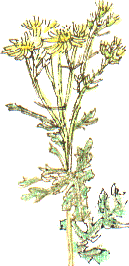 Derek Smith of Ragwort-UK very kindly wrote me an informative article about Ragwort poisoning in October 2002. I've had about a dozen e-mails over the years from people worrying about how they should deal with the plant. Now, in September 2011, there's a lively debate about just how poisonous Ragwort is to stock and to humans who handle it.
I thought of adding a few footnotes to Derek's article in the interests of balance but really it's beyond my skills to chair an informed debate about Ragwort poisoning so I've withdrawn the article and you now need to refer to his website (see link below) to understand his approach to dealing with the plant. I don't keep animals, I don't have a background in biochemistry and I've never been involved in clearing Ragwort, except for the odd rosette that springs up on our lawn.
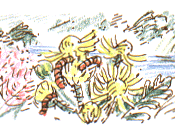 My feeling is that it's a plant that should be treated with some respect, so personally I'd err on the side of caution and take heed of Derek's advice, but who am I to judge.
I'd also make a plea for its value in biodiversity. We've  just come back from a weekend in Scotland and the moors were purple with heather and some of the rough field edges golden with Ragwort. It must make a huge contribution to Scottish insect life even though Highlanders dubbed the weed 'Stinking Billy' after William, Duke of Cumberland, or 'Butcher Cumberland' as they called him after the Battle of Culloden.
Please use your favourite search engine to follow the online debate and to find the latest medical and vetinary advice.
Link
DEFRA code of practice on how to prevent the spread of ragwort
Ragtime Memories: Ann Rothwell's (non-lethal) experience of picking ragwort
Ragwort-UK Ltd. breed Cinnabar
moth caterpillars for release as natural predators for the biological
control of ragwort.

Richard Bell,
wildlife illustrator
E-mail; 'richard@willowisland.co.uk'
Return to 'Poison-Flowers' diary entry for 12th October 2002. |
Nature Diary |
Home Page