 THE
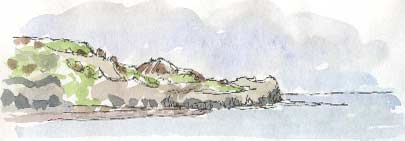
PROFILE of the headland of Sandsend Ness, two miles west of
Whitby, has been nibbled into by quarrying activity. The Jurassic
shales of the cliff top were processed, by a complicated process that involved
baking and soaking, to make alum, an essential ingredient in
dying textiles and leatherworking. In the mid-nineteenth century the alum industry
moved to the coalfields when a more efficient process of producing the salts
was developed.
THE
PROFILE of the headland of Sandsend Ness, two miles west of
Whitby, has been nibbled into by quarrying activity. The Jurassic
shales of the cliff top were processed, by a complicated process that involved
baking and soaking, to make alum, an essential ingredient in
dying textiles and leatherworking. In the mid-nineteenth century the alum industry
moved to the coalfields when a more efficient process of producing the salts
was developed.
In the 1880s, long after the collapse
of the local alum industry, a railway was constructed along the cliff top
with the intention of transporting iron
ore to Teeside but the scheme never flourished and the line closed
in 1958.
Rapakivi Granite
 In
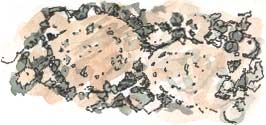
Cornish and Dartmoor granites the large fleshy-looking feldspar crystals are
often rectangular, dotted around in the matrix of smaller rock
crystals like a scattering of matchboxes seen edge-on. In Rapakivi
granite – which
is found in parts of Scandinavia – the feldspars have been remelted during
the process of crystallisation, giving them rounded edges, like half-melted
ice cubes. The tables at Trencher's Fish and Chip restaurant
in Whitby are made of
slabs of this granite.
In
Cornish and Dartmoor granites the large fleshy-looking feldspar crystals are
often rectangular, dotted around in the matrix of smaller rock
crystals like a scattering of matchboxes seen edge-on. In Rapakivi
granite – which
is found in parts of Scandinavia – the feldspars have been remelted during
the process of crystallisation, giving them rounded edges, like half-melted
ice cubes. The tables at Trencher's Fish and Chip restaurant
in Whitby are made of
slabs of this granite.
 Dinosaur
Delta
Dinosaur
Delta
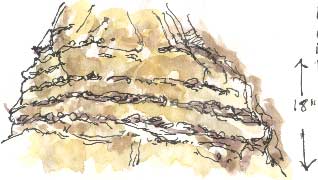
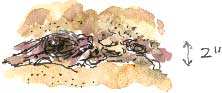 There are layers of nodular ironstone in buff sandstone 100 yards
west of the beach huts at Westcliff. The Jurassic sandstones around
Whitby date from about 180 million years ago. They were laid down in a river
delta at a time when dinosaurs such as Megalosaurus, Cetiosaurus and Camptosaurus
roamed on land.
There are layers of nodular ironstone in buff sandstone 100 yards
west of the beach huts at Westcliff. The Jurassic sandstones around
Whitby date from about 180 million years ago. They were laid down in a river
delta at a time when dinosaurs such as Megalosaurus, Cetiosaurus and Camptosaurus
roamed on land.